
From the Rumor Mill: Jessica Tisch at the MTA: A Case for Operational Leadership and a New Approach to Labor

Jessica Tisch deserves serious consideration as a potential leader of the Metropolitan Transportation Authority. Her record running New York City’s sanitation, technology, and police agencies offers a credible foundation for managing an institution whose success depends on daily execution, workforce coordination, public confidence, and the modernization of legacy systems. At the same time, her candidacy raises two consequential questions: how much operational authority she would delegate—or how she might pair with existing transit leadership—and whether her record of constructive engagement with municipal unions could translate to transit.
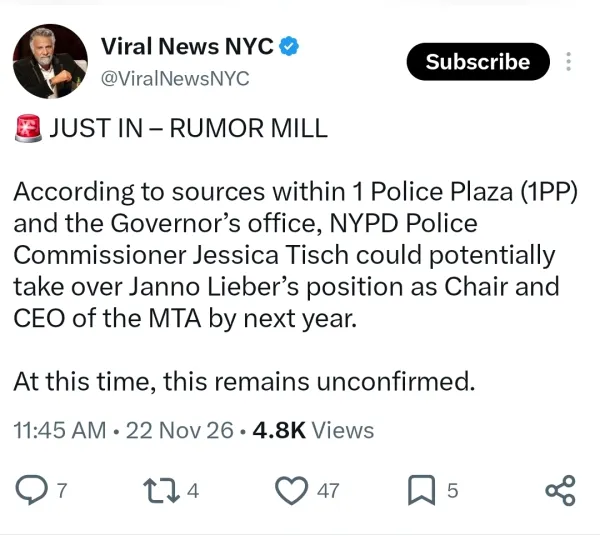
To be clear, this is an argument for considering her candidacy rather than a report of an impending appointment. While chatter on X has intensified—most notably a November 22, 2026 post from @ViralNewsNYC citing sources at 1 Police Plaza and the Governor’s office suggesting Tisch could succeed Janno Lieber next year, building on an August 5 post from transit union figure Tramell Thompson claiming Lieber was expected to leave by year’s end and initially naming MTA Board member and Capital Program Committee Vice-Chair Daniel Garodnick as the rumored replacement—neither Governor Kathy Hochul’s office nor the MTA has confirmed any leadership transition or outlined how the authority would be structured. Still, the timing of the Tisch rumor, emerging just days after Mayor Zohran Mamdani and Tisch disbanded the NYPD’s Strategic Response Group (SRG) on November 16, 2026, underscores why political and transit insiders are actively gaming out her next move.
Tisch’s strongest qualification is her track record of making large public agencies deliver visible results. At the Department of Sanitation, she oversaw containerization, collection overhauls, street cleaning, and snow removal. Earlier, as commissioner of the city’s technology agency and Deputy Commissioner of Information Technology at the NYPD, she managed citywide systems through the pandemic and helped modernize police communications, dispatch, and data infrastructure.
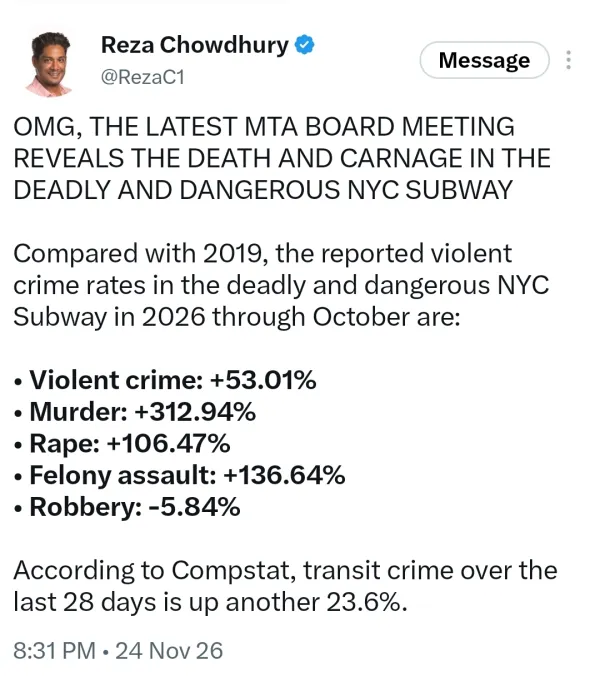
https://x.com/RezaC1/status/2125401835465044383
That background translates directly to two of the MTA’s defining operational imperatives: overseeing MTA Information Technology (MTAIT) and confronting violent crime on the subways. As a former city CIO and NYPD IT chief, Tisch would bring far deeper technical fluency to MTAIT than a traditional transit administrator—an asset when evaluating vendor contracts, modernizing aging signal and fare systems, defending critical infrastructure against emerging cyber threats, and deploying artificial intelligence responsibly rather than chasing costly, unproven pilots. Just as importantly, her tenure as NYPD Commissioner—where she oversaw precision deployment strategies, expanded camera networks, and helped drive major subway crime down to its lowest non-pandemic levels in over a decade—gives her firsthand command of how data-driven policing, station design, and mental health outreach intersect underground.
Even so, running police, sanitation, and technology agencies does not establish direct expertise in operating railroads or delivering mega-scale transit construction projects.
The strongest case for Tisch would therefore pair her managerial and technological discipline with an explicit commitment to empowered transit expertise. She would need seasoned executives capable of challenging her on engineering, maintenance, service planning, procurement, and capital construction—and the clear authority to act on those judgments.
That necessity leads directly to the question of how the chair and CEO roles are structured—and whether another rumored contender like Daniel Garodnick fits into the equation.
The MTA’s two top offices were reunited in 2009 following an earlier split, a consolidation intended to restore clear executive accountability after Richard Ravitch’s financing commission criticized the divided structure. Under current Public Authorities Law §1263(4)(a), the chair “shall be the chief executive officer,” while retaining the authority to appoint an executive director and other officials to handle executive and administrative functions. Formally separating the chair and CEO roles—such as making Tisch chairwoman and Garodnick CEO—would require state legislation.
There is recent precedent for attempting such a split. In 2021, Governor Andrew Cuomo sought to install Sarah Feinberg as chair and Janno Lieber as CEO, a proposal that stalled amid pushback over accountability and gubernatorial control.
Reviving that legislative battle would not only be an uphill fight in Albany, it would also misalign their strengths. Tisch is a hands-on operator, not a ceremonial board chair; sidelining her from daily execution would blunt her greatest asset. Garodnick, meanwhile, is a respected civic strategist, former three-term councilmember, and former City Planning Director known among peers and building-service unions as a pragmatic consensus builder—not a 24/7 rail operations executive.
A far more practical blueprint exists within current law. Tisch could retain the unified Chair and CEO post—anchoring daily execution, MTAIT modernization, subway safety coordination, and agency-wide accountability—while delegating rail and construction execution to veteran operating presidents like NYC Transit’s Demetrius Crichlow and Construction & Development’s Jamie Torres-Springer. If Albany and City Hall wanted to harness Garodnick’s political and capital-planning acumen alongside her, the cleaner hybrid would be appointing him under §1263(4)(a) as an Executive Director or senior deputy focused on capital delivery, zoning value capture, and legislative negotiations, rather than splitting the top title. Delegation only works when employees, board members, and the public know exactly who makes decisions and who answers for them.
Her relationship with organized labor offers an equally compelling basis for optimism.
The most persuasive evidence comes from former sanitation union president Harry Nespoli. In a September 2026 interview, he described Tisch as accessible, hardworking, prepared, and willing to address grievances directly—portraying a demanding commissioner who listened and worked through disagreements. That carries far more weight than ceremonial praise at an appointment press conference.
That rapport also accompanied substantive bargaining. When the city announced its tentative sanitation contract in October 2023, both Tisch and Nespoli credited their working partnership. The deal paired wage increases and parental leave with reforms to contractual productivity programs. While the mayor’s labor negotiators deserve substantial credit, the outcome shows that Tisch can pursue operational reform without alienating the workforce executing it.
Police unions have offered similar backing. PBA President Patrick Hendry welcomed her retention as commissioner under Mamdani in November 2025, citing her grasp of officers’ daily realities. That support is not unconditional—police unions sharply criticized the November 2026 disbanding of the Strategic Response Group—but a functional labor relationship can withstand policy friction without collapsing.
At the MTA, Tisch would have to build that trust from the ground up across a vast, specialized workforce—from train operators and maintenance crews to engineers, technical specialists, and administrative staff.
The broader opportunity lies in treating frontline employee knowledge as a core input to management strategy. Transit workers—and the technical professionals maintaining the system’s digital and physical backbone—see where equipment, safety, procedures, staffing, and communications break down because they navigate those failures every shift. An MTA chair who treats that ground-level insight as actionable evidence could simultaneously strengthen labor relations, sharpen technology adoption, and improve service delivery.
Tisch’s record justifies taking her candidacy seriously. It neither guarantees smooth contract negotiations nor erases her lack of rail and transit-construction experience. Her strongest pitch would rest on combining decisive agency management, empowered transit specialists, deep technological literacy, and a labor relationship built on accessibility and follow-through. Titles matter because they assign authority, but what would ultimately define her tenure is how she wields that authority—and whose expertise she brings into the room.
https://x.com/progressiveact/status/2085116837356814634