
A Day in the Life of a Transit Worker or How Dangerous is Your Work Assignment Location

Earlier this month we had a blog post about geographic retaliation at the MTA called MTA’s Vast Network as Quiet Leverage: How Geography Can Mask Retaliation.
The impact of reassigning someone to a shop has second order effects that is invisible to management. The dangerous impacts of working at a remote location (from where you live) can even start at your doorstep…
Our Public Relation Officer was recently assigned to field work one day a week at East New York. Not only did his reporting time go back 15 minutes (7:15 am to 7:00 am) but there is an extra 1+ hours of commuting time (each way). This means he has to wake up earlier and leave earlier to report to work.
Our officer lives on a private street which means the deed of his house includes the sidewalk, street and parking directly in front of his residence. Now ordinarily when a weird guy walks down the street and does creepy stuff there is not much you can do in the wild west we call New York City…. However, if an uninvited guest (a creepy one no less) walks down a private street it is called criminal trespassing.
Video of Creepy Guy
https://youtube.com/shorts/th5bfQa6xd0
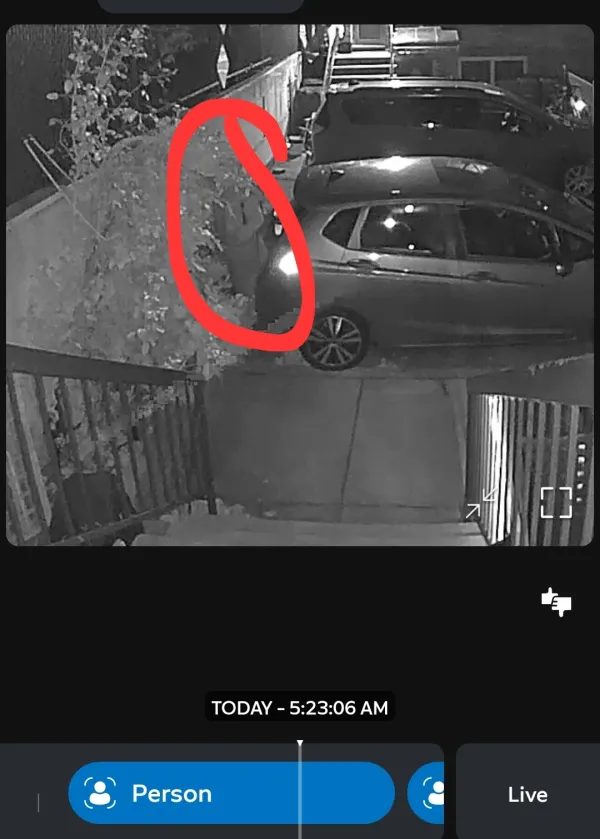
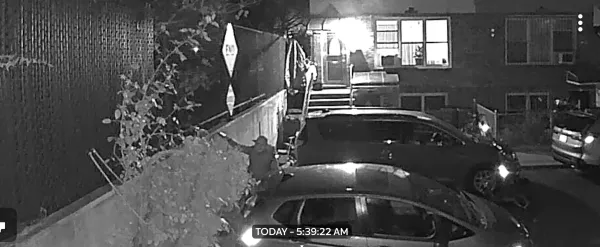
By leaving the house earlier in the morning in the cloak of darkness Brian has found found there is a weird guy each morning hiding in his bushes behind his car at the end of his dead end street taking pictures of the wall. No, he isn’t taking pictures of what’s over the wall, he is shuffling around and taking pictures of the wall and himself.
This has made going to work a nerve wracking experience.
Brian missed the trespasser by less than four minutes after leaving his home for East New York
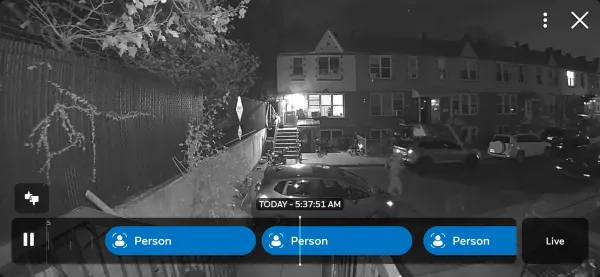
Trespasser Leaving
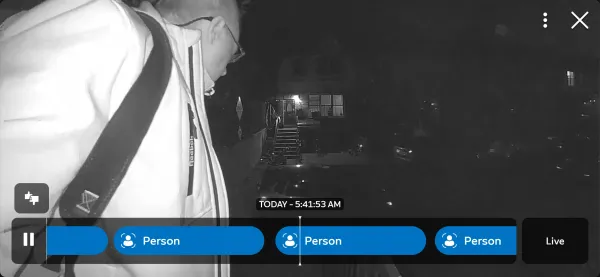
Brian Leaving For Work
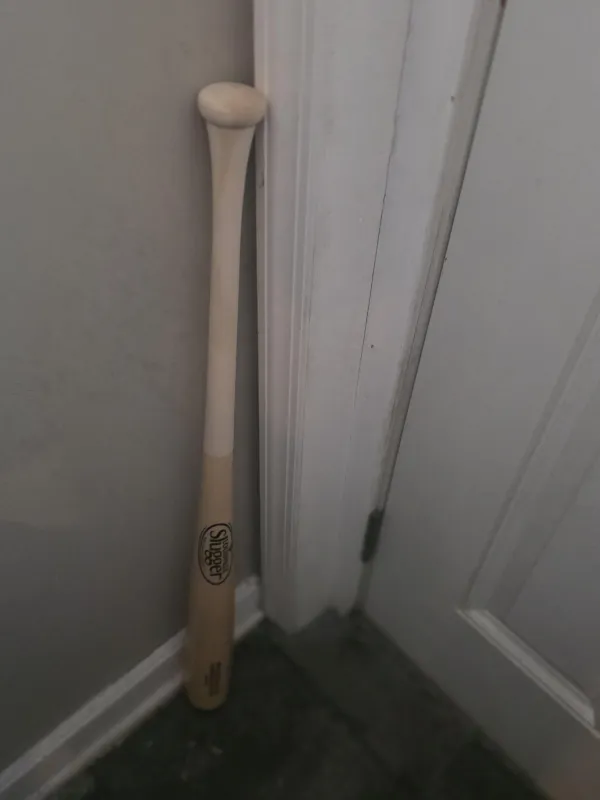
Louisville Slugger® placed behind Officer's Front Door for protection
We had to put up Private Road No Trespassing signs at the front of the street and at the end of the block (adjacent to our home) because it is reasonable that the trespasser doesn’t even realize that they are on a private street. And I assume most of you who are reading this didn’t even know that private streets with residences are a part of NYC infrastructure.
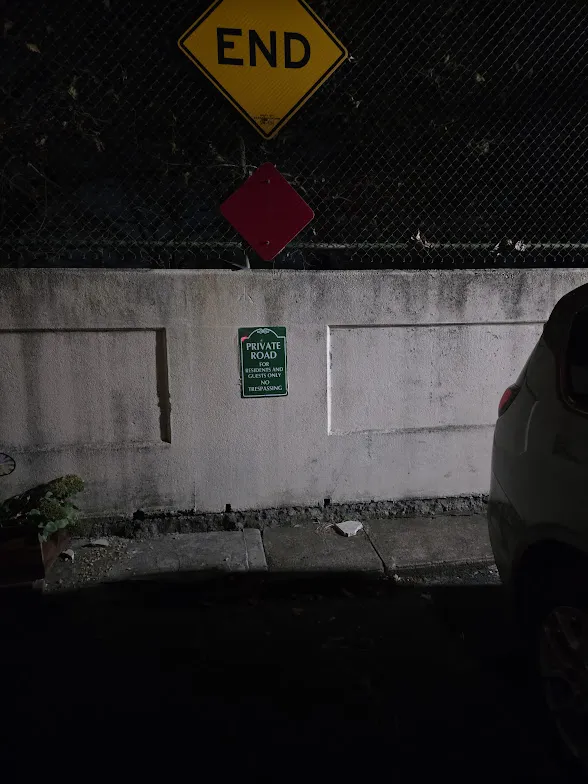
However the trespasser continued to trespass even after posting signage.
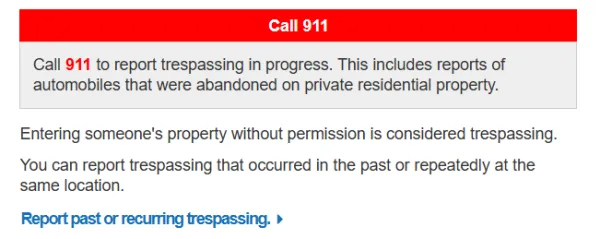
So a 311 Report was filed. 311 conveniently includes the option reporting “repeat trespassing”
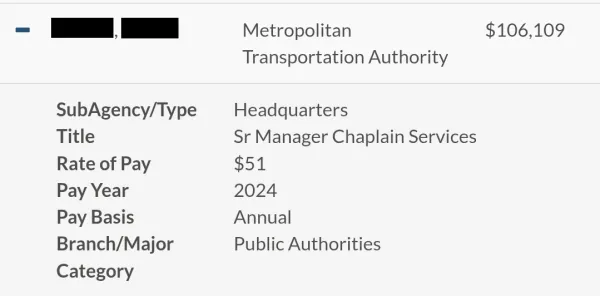
After the third non-responsive submission of a 311 report which includes some of the photos and videos we have posted here, Brian attempted to reach out to the MTA Chaplain for assistance who also is a chaplain for Transit Police. At a minimum he was expecting the Chaplain just to put the good word at 311, the local precinct and / or the Precinct Community Affairs Officer (who Brian emailed several times without acknowledgement).
The request was reasonable within the MTA chaplaincy’s published employee support mission. The MTA describes its Office of the Chaplains as providing free, confidential chaplaincy care, while an October 2026 management posting places the office within the broader employee assistance structure. That said, neither description establishes a duty to obtain police intervention, but both support an employee’s decision to seek assistance.
The program’s documented practice also extends beyond incidents on transit property. Reporting on MTA chaplains describes assistance with financial difficulties, family adversity, hospital visits and personal loss. The circumstances prompting that support need not originate in the workplace.
However Brian was shocked to get a response from the Chaplain “Unfortunately, because this is not an MTA matter or on MTA property it’s out of my jurisdiction and work scope.”
And further:
“I am wondering if part of the delay is that these pics/videos are not showing any crimes or illegal activities taking place. Nothing in the video or pics attached say he is even a trespasser, apart from your testimony.”
Brian simply replied:
“Under New York Penal Law (§ 140.05 and § 140.10), entering or remaining on a private road that is conspicuously posted with "No Trespassing" signs constitutes criminal trespass (even if the street isn't gated), and the Ring video plus photos of the posted signs establish clear prior notice.”
So finally after reopening the third 311 ticket and placing a fourth ticket, NYPD was dispatched during the day to canvass the area…which is a little strange considering each time he selected that the illicit activity was around 5:30 in the morning (which is when you would expect the police to show). Nevertheless Brian was able to get NYPD on the phone and they agreed the behavior of the individual was bizarre and asked what Brian thought the person was doing.
One possibility… even though a remote possibility that was relayed was that the individual is playing Pokémon Go. So our Public Relation Officer also reported to Pokémon that we live on a private street:
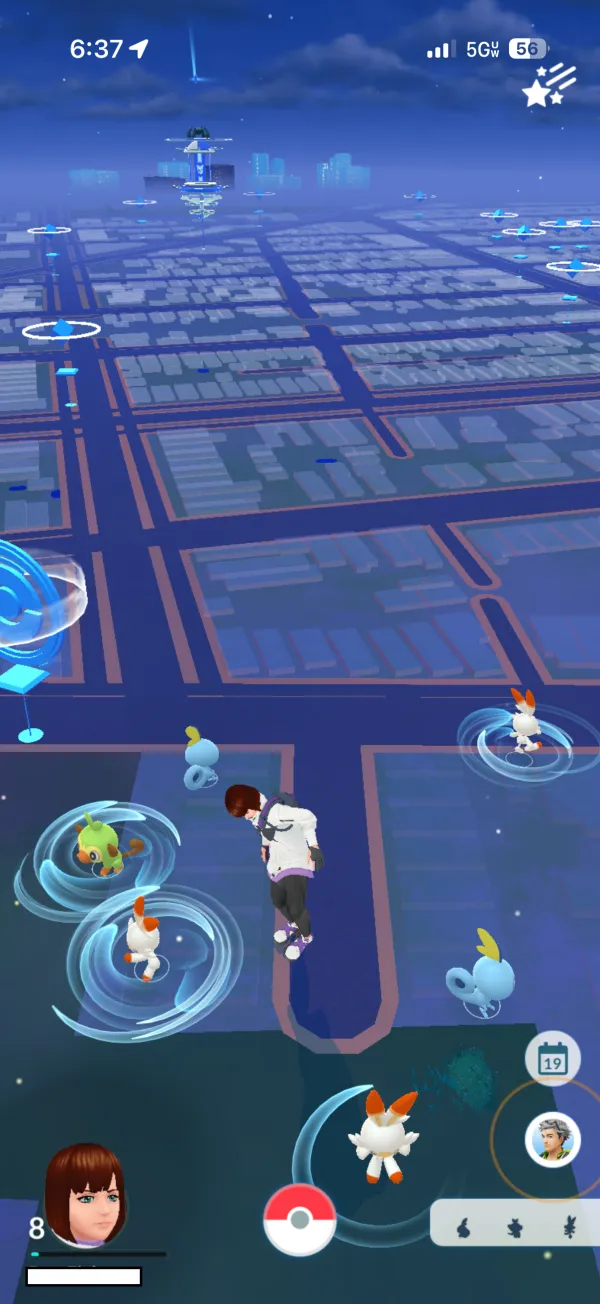
Pokémon Go Screenshot Provided by an invited guest of Brian Showing Pokémon to collect on a private street.
To remove a PokéStop, Gym, or route on a private street in Pokémon GO, submit a location removal request through Pokémon GO Live as a verified property owner Request modification or removal of a PokéStop or Gym — Pokémon GO
The officer sounded sincere and he said he would relay the information to the night tour because they were the ones who able to intercede. Brian asked if it was annoying to the police by continuing to report the trespasser via 311 and the officer not at all and do what you have to do but if you see trespassing in the act call 911.
Of course the ticket was closed and the Tre4spasser came this morning
We have some more ideas on how deal with the Trespasser and will keep you posted via our weekly news digest....
So once out the door and on the way to work what do Brian, his board member and union members face?
Well we already established that early in the morning and late at night (we are a 24 / 7 facility) that it can be more dangerous. But what about traveling to our various shops?
New York City Transit operates an extensive network of 16 railcar maintenance and overhaul shops distributed across Manhattan, the Bronx, Brooklyn and Queens. Although these facilities collectively support the operation of the subway system, the neighborhoods surrounding them have substantially different reported crime levels.
For employees assigned to these facilities, workplace safety should not necessarily be considered something that begins and ends at the facility entrance. The surrounding neighborhood, accessibility of public transportation, walking distances and hours of reporting are legitimate considerations in evaluating employee safety.
Hopefully this blog post and the possibility of Jessica Tisch the current Police Commissioner who may become CEO of the MTA (see Jessica Tisch at the MTA: A Case for Operational Leadership and a New Approach to Labor From the Rumor Mill: Jessica Tisch at the MTA: A Case for Operational Leadership and a New Approach to Labor | Metropolitan Transportation Authority (MTA) Technical Professional Employees Local 3652 ) would come together with her union partners and help resolve public safety issues facing our members who are the “eyes and ears” of the system and that shouldn’t necessarily finish when our members exit a subway station to walk over to a nearby shop to report to work.
An analysis of NYPD CompStat figures for January 1 through November 15, 2026, provides a preliminary framework for comparing these locations.
Ranking the 16 maintenance and overhaul shops
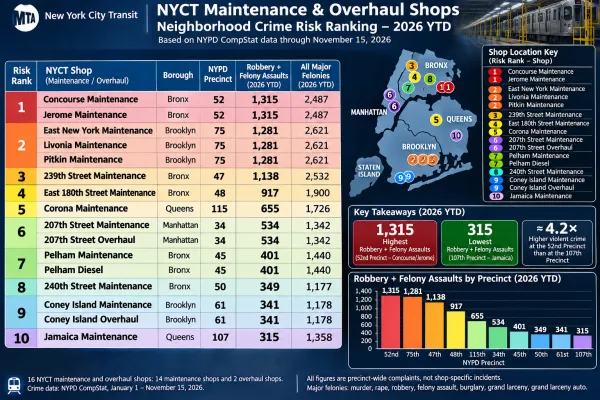
The analysis prioritizes robbery and felony assault complaints because these offenses are particularly relevant to employees traveling to and from their assigned workplaces. The combined total of the seven major felony categories provides a secondary measure of neighborhood crime.
The 16 facilities are divided into 10 precinct-based ranking groups, with facilities located within the same precinct receiving identical rankings.
1. Concourse Maintenance and Jerome Maintenance — Bronx, 52nd Precinct
The precinct recorded 1,315 robberies and felony assaults and 2,487 major felonies, placing these two facilities at the top of the preliminary ranking for reported violent crime volume.
2. East New York Maintenance, Livonia Maintenance and Pitkin Maintenance — Brooklyn, 75th Precinct
The precinct recorded 1,281 robberies and felony assaults and 2,621 major felonies. Although ranked second for the selected violent offenses, it recorded the highest overall major-felony total among the precincts included in this comparison.
3. 239th Street Maintenance — Bronx, 47th Precinct
The precinct recorded 1,138 robberies and felony assaults and 2,532 major felonies, placing it third in the ranking.
4. East 180th Street Maintenance — Bronx, 48th Precinct
The precinct recorded 917 robberies and felony assaults and 1,900 major felonies.
5. Corona Maintenance — Queens, 115th Precinct
The precinct recorded 655 robberies and felony assaults and 1,726 major felonies.
6. 207th Street Maintenance and 207th Street Overhaul — Manhattan, 34th Precinct
The precinct recorded 534 robberies and felony assaults and 1,342 major felonies.
7. Pelham Maintenance and Pelham Diesel — Bronx, 45th Precinct
The precinct recorded 401 robberies and felony assaults and 1,440 major felonies.
8. 240th Street Maintenance — Bronx, 50th Precinct
The precinct recorded 349 robberies and felony assaults and 1,177 major felonies.
9. Coney Island Maintenance and Coney Island Overhaul — Brooklyn, 61st Precinct
The precinct recorded 341 robberies and felony assaults and 1,178 major felonies, placing the Coney Island facilities in Gravesend among the lowest-ranked locations under this methodology.
10. Jamaica Maintenance — Queens, 107th Precinct
The precinct recorded 315 robberies and felony assaults and 1,358 major felonies, representing the lowest combined robbery and felony-assault count among the precincts examined.
A substantial geographic disparity
Preliminary comparison using previously compiled NYPD CompStat figures through November 15, 2026.
The difference between the highest and lowest precincts is substantial.
The 52nd Precinct, associated with Concourse and Jerome maintenance shops in this preliminary analysis, recorded approximately 4.17 times as many robberies and felony assaults as the 107th Precinct, associated with Jamaica Maintenance.
The difference between the 75th Precinct and the 61st Precinct is similarly noteworthy. Despite both being located in Brooklyn, the former recorded approximately 3.76 times as many robberies and felony assaults.
Even the difference between the 207th Street facilities in northern Manhattan and the Coney Island facilities in southern Brooklyn is significant. The 34th Precinct recorded approximately 57% more robberies and felony assaults than the 61st Precinct.
These differences do not establish equivalent increases in an individual employee's probability of victimization. Nevertheless, they demonstrate why geographic differences should not be automatically dismissed when evaluating workplace assignments.
The invisible extension of the workplace
Traditional occupational safety assessments concentrate on hazards within the workplace: machinery, electrical equipment, moving trains, chemical exposure, noise and industrial accidents.
However, an employee's exposure to potential hazards does not necessarily end at the perimeter of an industrial facility.
Many NYCT maintenance and overhaul shops are situated in industrial areas where employees may be required to walk along relatively isolated streets, pass underneath elevated infrastructure, traverse poorly illuminated areas or travel substantial distances between subway stations and facility entrances.
Employees reporting during early-morning hours or departing late at night may encounter conditions substantially different from those experienced during conventional business hours.
This creates what might be described as the geographic externality of a workplace assignment: a potential safety consequence generated by management's selection of an employee's reporting location but occurring outside the formal boundaries of the workplace.
Such consequences may never appear in conventional occupational injury statistics.
Reassignments and the second-order effects of management decisions
When an employee is reassigned from one maintenance facility to another, management may view the decision primarily through the lens of staffing requirements, operational efficiency or administrative convenience or geographic retaliation.
Yet a reassignment can generate several second-order effects, including longer commutes, earlier departures from home, additional subway transfers, increased walking distances and exposure to different neighborhood crime conditions. Eating meals at non-traditional times, less sleep and less time spent with family.
A transfer between Coney Island and 207th Street, for example, is not simply a change between two facilities performing comparable functions. It can represent a substantial change in commuting geography, travel time and surrounding neighborhood conditions.
The MTA's vast geographic footprint makes these considerations particularly relevant. Few employers possess a comparable ability to change an employee's reporting location across such an extensive urban transportation network.
A reassignment does not have to involve a reduction in salary, title or benefits to impose additional burdens on an employee.
Toward a geographic employee-safety assessment
NYCT should consider developing a standardized geographic safety assessment for its maintenance and overhaul facilities, incorporating publicly available crime data alongside its existing occupational safety programs.
Such an assessment could include:
* NYPD precinct-level crime statistics and population-adjusted crime rates.
* Geocoded robberies and felony assaults within a quarter-mile and half-mile of facility entrances.
* Crime patterns during employee reporting and departure hours.
* Walking routes between facilities and public transportation.
* Street lighting, pedestrian infrastructure and security-camera coverage.
* Availability of secure employee parking, transportation and alternative entrances.
* Employee-reported safety concerns and documented incidents.
The assessment could be periodically updated and made available to management, occupational safety personnel and the unions representing employees assigned to these facilities.
It could also inform decisions involving permanent transfers, temporary assignments and changes to employees' tours of duty.
The MTA routinely evaluates infrastructure, equipment and operational risks throughout its transportation network. It should also recognize that geography can influence employee safety.
The preliminary 2026 NYPD crime comparison suggests that the neighborhoods surrounding NYCT's maintenance and overhaul shops are not interchangeable. Some associated precincts recorded more than four times as many robberies and felony assaults as others.
The objective of this analysis is not to stigmatize neighborhoods or suggest that particular maintenance facilities are inherently unsafe. Rather, it is to establish that geographic differences are measurable and deserve consideration when management makes decisions affecting where and when employees report to work.
An employee's reporting location is not merely an administrative designation. It is a management decision with potentially measurable safety consequences.
Recognizing those consequences would represent a meaningful expansion of the MTA's approach to employee safety.
Methodology and limitations: This preliminary analysis uses the previously compiled 2026 YTD precinct figures through November 15, ranked by combined robbery and felony-assault complaints. Exact precinct assignments for East New York, Livonia, Corona, Pelham Maintenance and Pelham Diesel require further verification. The underlying figures have not been independently reverified for this essay. Precinct-wide complaint totals are not population-adjusted crime rates or measurements of individual employee risk. These limitations should be resolved before formal publication.